
Aperture Institute
Two things get built here: operating systems, and the machinery language models use to decide what to do. Both from scratch, both on hardware we own, and both measured before anything is claimed about them.
The results below include the ones that did not work. A reasoning architecture that scored 0.0% is on this page beside a released operating system, because the reason it failed is worth more than the fact that it failed, and because a page showing only successes is not a record of research.
Projects all →
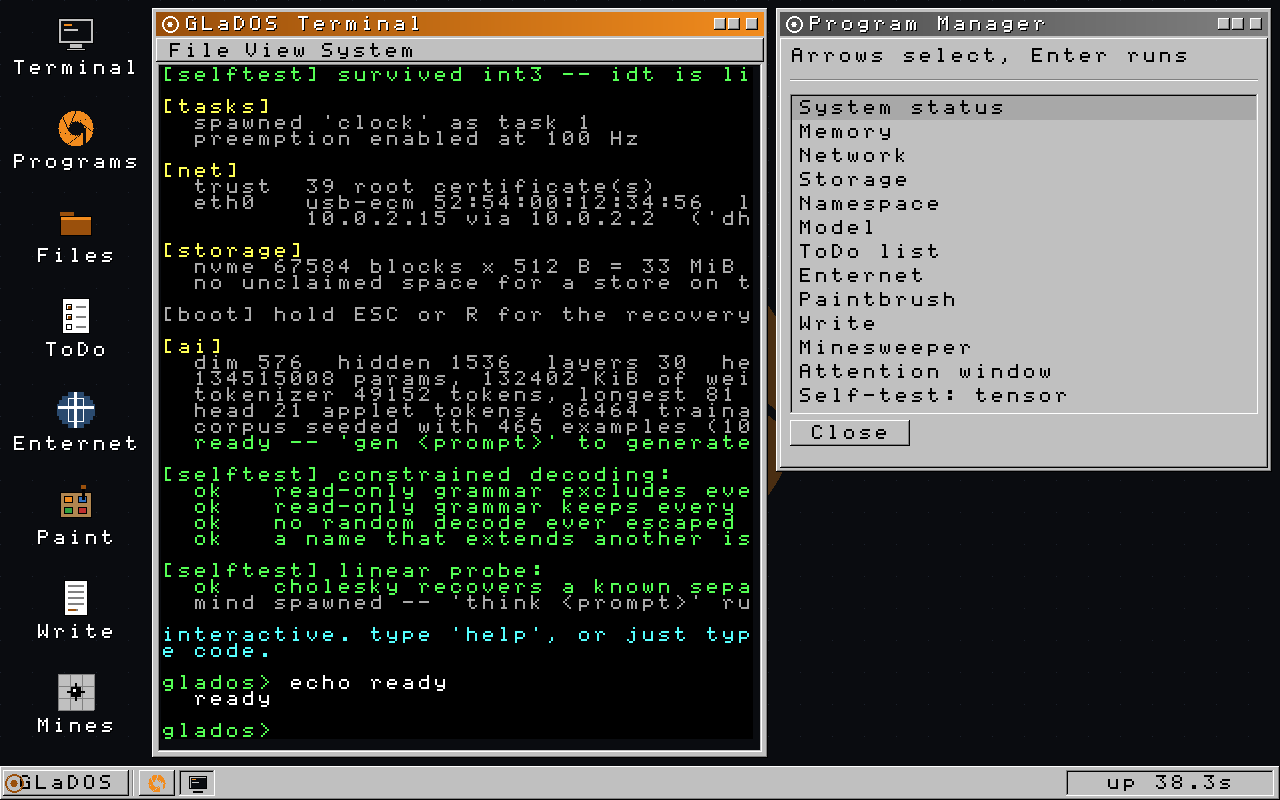
A from-scratch, non-Unix operating system in Rust. No user/kernel split, no syscalls, no process isolation, one address space — so a tool call from the model is a function call rather than a protocol. It boots on real hardware from its own bootable image.
Everything under it was written here: the TLS 1.3 client, the X.509 chain validation, the NVMe and Ethernet drivers, the FAT reader and writer, the AML interpreter that reads the battery, the window manager, the tokenizer, and the forward pass. The dependency count in the strip above is not a rounding — the crate has none, by policy.
- Signed kernel images, staged before
ExitBootServices, with rollback if the trial boot fails - A closed-form router that decides in about 1.6 ms with no transformer forward pass at all
- Its own systems language, and a self-modification loop with four judges in front of it
$ globular --score

variant                   route
1  latent field         0.0%
2  latent re-entry   destructive
3  best-of-K          +6.7pp

adopted: gate-first routing
(agent.rs)A reasoning architecture built on populations of latent hypothesis-agents evolving through field dynamics. Three variants were built and scored against a frozen checkpoint. Two failed, and the headline features of the original turned out to be dead code that never ran.
What survived is smaller and duller than the metaphor: selection is the whole value, and a population is worth only as much as the selector in front of it. That one mechanism is in the kernel now.
rail            135M    0.8B     2B
MMLU           20.0%   30.0%  43.3%
GSM8K           0.0%    0.0%   0.0%
NIAH            0/7     6/6    6/6
Route           0.0%   33.3%  40.0%

chance: MMLU 25%, route ~1.3%
Baselines taken before any capability work, because the rule this project runs under — measure before building — needs numbers to protect.
GSM8K reads 0.0% for every model including the largest, and that row stays on the page. Small models fail arithmetic, the fix is a tool rather than more parameters, and a benchmark table that quietly dropped its worst row would be worth nothing.