
Projects
One, for now. This page lists what has been published, and nothing is listed here before it exists somewhere a person can read it.
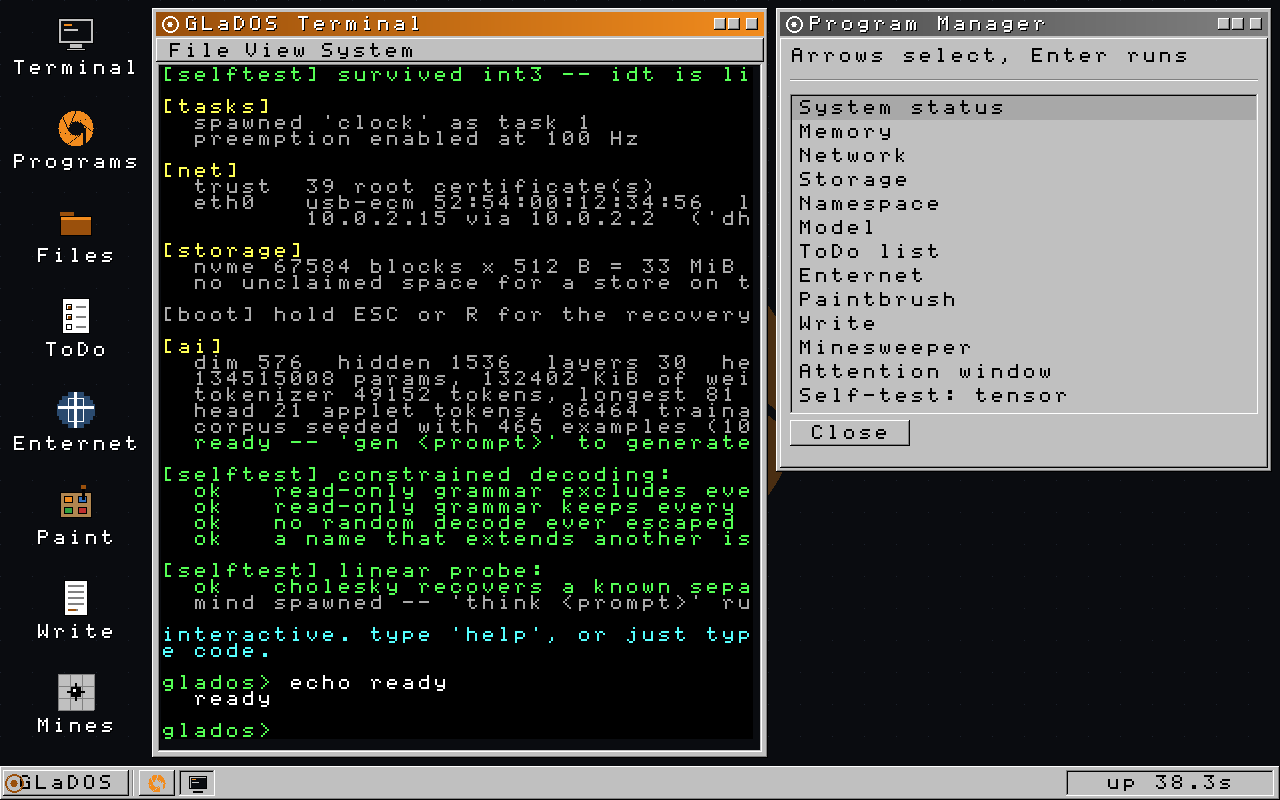
GLaDOS
A from-scratch, non-Unix operating system in Rust, built around a language model that lives inside the kernel. No user/kernel split, no syscalls, no process isolation, one address space.
It boots on real hardware from its own image, brings up its own NVMe and Ethernet controllers, speaks TLS 1.3 to the network, reads the battery by interpreting the firmware's own bytecode, and runs a window manager it also wrote.
What is actually in it
The claim worth checking on this page is the dependency count, because it is the one that decides what everything else means. The crate has none. The list below is not integration work.
| Area | Written here |
|---|---|
| Boot | UEFI application that is itself the kernel — no ELF loading, no relocation, no handoff ABI. Own page tables after ExitBootServices. |
| Network | Ethernet, ARP, IPv4, ICMP, UDP, DHCP, DNS, TCP with RFC 6298 retransmission, TLS 1.3, X.509 chain validation. |
| Crypto | ChaCha20-Poly1305, X25519, P-256 and P-384 ECDSA in Jacobian coordinates, SHA-1/256/512, HKDF, RSA verify. Every one checked against published vectors at boot. |
| Storage | NVMe driver, FAT16/32 reader, FAT32 writer behind a ranged write gate, and a content-addressed Merkle store. |
| Firmware | ACPI table parsing and an AML interpreter, because battery state lives behind bytecode the firmware ships and there is no other way to read it. |
| Graphics | Linear framebuffer, software compositor with row-span diffing, window manager, and three applications. |
| Language | Aiksi: lexer, parser, tree-walking evaluator, a capability gate, and a code generator that emits x86-64 into the heap and calls it. |
| Model | Tokenizer, forward pass, int8 kernels, KV cache, constrained decoding, a closed-form router, QDoRA adapters and the backward pass to train them. |
The one exception is stated in the repository and repeated here:
src/dev/rtl8188eu_tables.rs holds RTL8188EU initialisation
tables taken from Linux's GPL-2.0 rtl8xxxu driver, because there is no other
source for them. It is one file, marked as such at the top, and nothing else
in the tree came from anywhere.
How it is tested
There is no cargo test. It is a no_std UEFI
binary with no host test runner, so verification is twenty-six selftest
sections at boot — twenty-four of which are also re-runnable on demand
as named suites — plus driving the shell over a serial socket under
QEMU. That output is the test suite, and it is printed on every boot.
What QEMU cannot reach is stated rather than glossed: it models no embedded controller, so every battery figure seen under emulation is the firmware's fallback branch; it emulates an 8139 rather than the 8168 in the target machine; and it has no model of the wireless part at all.
The machine
One laptop, an MSI GF63 Thin, board MS-16R8. Portability is not claimed. Graphics should carry anywhere UEFI hands over a framebuffer; storage and networking are chip-specific and would need drivers that do not exist.